
On this page 8 sections
What Task 8 asks you to do
The screen shows a picture of something unusual, and you're on the phone with someone. Your job is to describe the object so well that they could picture it without seeing it. Then do what the prompt asks: offer to buy it for them, check whether it's theirs, or make a complaint.
Scorers look at content and coherence, vocabulary, listenability and task fulfillment. In this task, task fulfillment means two things. The person on the phone can picture the object from your words alone, and you do the action the prompt asks for. A beautiful description that never asks “Do you want it?” has left out part of the task.
Write the action at the very top of your notes, before you look at the picture properly. Once you start describing, it's easy to get lost in the details and forget why you called.
Use your prep time
Thirty seconds goes fast, so use it in this order. First, note the action, so you don't forget it. Then run a quick checklist on the picture: size, shape, colour, material, parts, texture and what it does. Add one comparison (“it looks like ___”). Finally, pick the 3–4 most unusual features. You can't describe everything, and you don't need to.
Key words only, no sentences. Here are my notes for the sample answer further down:
Action:   Maya → buy it? ($40)
Overview: garage sale, rocking chair
Big:      waist high, mint green, wood, smooth
Weird:    bookshelves, cup hole, lamp
Like:     library in a chair
The four-move answer
Every strong Task 8 answer I've scored does these things in this order. The timings are a guide, not a rule. Move 4 is optional. If you're cut off in the middle of it, that's not marked down.
- 0–10s1. Open the call and give an overview
Where you are and what you've found, in one or two sentences. A quick greeting fits here, but it's optional.
Hi Jill, I'm at the flea market and I've just found the strangest chair.
- 10–48s2. Describe it, big picture to details
Overall shape and size, then colour and material, then the unusual parts, then what it does or how it works.
Picture a rocking chair, but with a little bookshelf built into each side.
- 48–56s3. Do what the prompt asks
Ask if they want it, check whether it's theirs, or complain. It's part of the task, so don't skip it.
So, do you want me to grab it for you?
- 56–60s4. Close the call (optional)
One quick line if there's time. A missing one costs nothing.
Text me back, okay? They're packing up soon.
The big-to-small order is the same one CELPIP's own Level 12 sample follows: an overview first, then precise details. The listener can't see the picture, so give them the outline before you fill it in.
Lines that work
These are frames to adapt to your own picture, not lines to memorise. Pick one or two from each row that sound like you.
| What you're doing | Lines |
|---|---|
| Opening the call | Hi ___, you won't believe what I just saw at ___. |
| Giving the overview | It's a ___ about the size of a ___. · Picture a ___, but ___. |
| Adding details | It's made of ___, and it's ___ to the touch. · On the top, there's ___. · The weirdest part is ___. |
| Comparing | It looks a bit like ___. · It's shaped like a ___. |
| When you don't know the word | There's a thing for ___ing. · a kind of ___ that ___ |
| Doing the action | So, do you want me to grab it for you? · Is this the one you lost? |
No word for a part? Don't stop. Build a phrase from easy words, like “a kind of hook that holds your keys”. It sounds natural and the listener still gets the picture.
A sample answer, marked up
In this sample, the speaker is at a garage sale. The prompt asks them to call their sister, who is setting up a reading corner, describe the item and ask whether she wants it. Here is the picture.
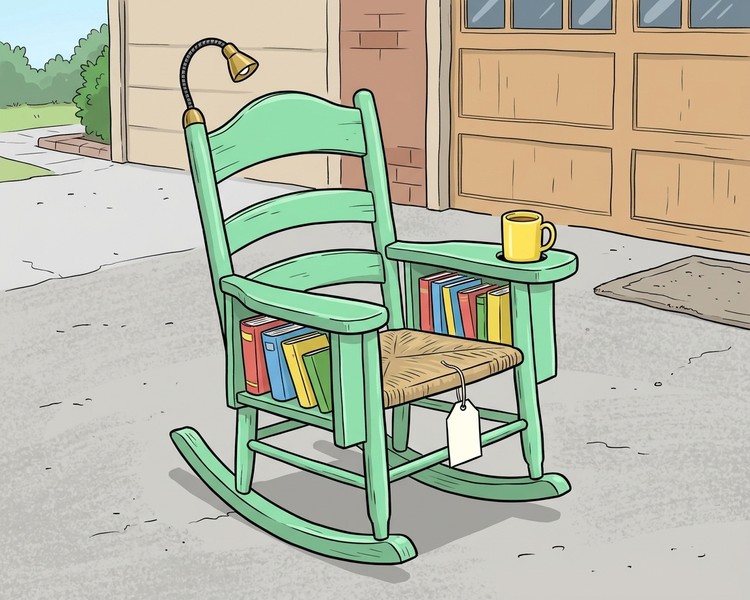
Switch between the two versions to see what changed between the first attempt and the second.
Hi Maya, it's me. I'm at a garage sale on Elm Street, and I've just found the perfect chair for your reading corner.1
Picture an old wooden rocking chair, about as high as my waist, painted this soft mint green. It's solid wood, and it's really smooth to the touch, like someone sanded it by hand.2 But here's the weird part. On both sides of the seat, there's a little built-in bookshelf, so you can keep three or four books next to you. On top of that, the right arm has a round hole cut into it, a kind of cup holder for your tea.3 And there's a small brass lamp on a bendy arm sticking up from the back, so you can point the light straight onto your page. It looks a bit like a library squeezed into one chair.
They're only asking forty dollars. So, do you want me to grab it for you before someone else does?4
Hello Maya. I am at a garage sale. There is a very strange chair here.1 It has a lamp. It is green and it has books on the sides. It has a cup holder also.2
The chair is very unique and bizarre and quirky.3 It is old but it is nice. It is a rocking chair and it is made of wood. I think it is a good chair for you.
It is forty dollars. Okay, bye.4
The first attempt is about 75 words and stops early. The second is about 160, at a steady, natural pace. Aim for 130–160 words.
What keeps you at CLB 7
Try it now
Use the four moves on a new picture. Start the timer for your 30 seconds of preparation, then record your answer in the practice app for a CLB score.
Your friend Omar left his umbrella at the hotel where you're both staying. The front desk shows you this umbrella from the lost and found. Call Omar, describe it, and check whether it's his.

Recording and scoring open in the Celppro practice app.
Frequently asked questions
What if I don't know the name of the object or one of its parts?
Don't stop to search for it. Build a phrase from easy words, like “a kind of hook that holds your keys” or “a thing for opening jars”. The listener still gets the picture, and it sounds natural.
Do I really have to do the action the prompt asks for?
Yes. Asking if they want it, checking whether it's theirs or making the complaint is part of the task. Write it first in your prep notes and save about 10 seconds for it.
How many details should I describe?
Pick the 3–4 most unusual features. You can't describe everything in 60 seconds, and you don't need to. A few features with what each one does beat a long list.
Can I add details that aren't in the picture?
Stick to what you can see. Describing things that aren't there, or details that don't help the listener picture it, uses up time without adding anything. One useful detail from the picture, like the price, is worth more.
Should I greet the person and say goodbye?
A quick greeting suits this task, because you're on the phone with someone. A closing line is optional. A missing one costs nothing, and being cut off mid-sentence isn't marked down.
Put this guide into practice
Try the strategy on a real Speaking task and get a CLB score straight away.
Deep scored CLB 12 in CELPIP and built Celppro after coaching students one-on-one. He reviews every guide against the current test format.