
On this page 8 sections
What Task 4 asks you to do
You see a scene with lots going on, the same kind of picture as Task 3. This time you don't describe it. Your job is to say what will happen next, for several people in the picture, and point to the clue that tells you.
Scorers look at content and coherence, vocabulary, listenability and task fulfillment. In this task, task fulfillment means one thing: you predict. Describing the picture again costs you a level, and an answer with no predictions at all is capped at CLB 5. Each prediction should also rest on something the listener could see in the picture.
Every prediction gets the same shape: what you see now, what will happen, and how they'll feel after. Once that shape is a habit, you stop drifting back into describing, and that drift is what costs most students a level here.
Use your prep time
You have 30 seconds. Don't try to plan the whole minute. Spend it finding four or five “about to” moments: someone reaching for something, leaning too far, carrying too much, looking at a watch, or clouds rolling in. For each one, note the clue and the result in two words. Keep the same order you used in Task 3, left to right or front to back, so you aren't searching the picture while you speak.
Key words only, no sentences. Here are my notes for the sample answer further down:
Order:      left → right
Noodle boy: whistle → bench
Sleeper:    pink → sunburn
Diver:      scared → climbs down
Dad:        4 slushies → spills
Clouds:     rain → change rooms
The three-move answer
Every strong Task 4 answer I've scored has this shape. Moves 1 and 3 are optional and short. Almost the whole minute goes on move 2. If you're cut off in the middle of a prediction, that's not marked down.
- 0–5s1. One short opening line (optional)
No overview needed: the listener already heard about the scene in Task 3. Go straight into your first prediction, or set it up in one line.
In the next few minutes, things are going to get even busier.
- 5–55s2. Four or five predictions, in order
For each person: the clue you can see now, what will happen, then how they'll feel or what comes after. Mix “going to”, “will”, “might” and “probably”.
The boy is leaning way over the edge of the fountain, so he's probably going to slip in. His mom will be annoyed, but he'll think it's hilarious.
- 55–60s3. How the scene will end (optional)
One line about the whole scene, if you have time. If you don't, stopping after your last prediction is fine.
By the end of the afternoon, the whole place will be empty.
Four or five predictions is a target, not a rule. Three that each have a clue and a follow-on beat six bare ones.
Lines that work
These are frames to adapt to the picture in front of you, not lines to memorise. Pick one or two from each row that sound like you.
| What you're doing | Lines |
|---|---|
| Making a prediction | ___ is going to ___. · I think ___ will ___. · ___ might ___, especially if ___. |
| Giving the clue from the picture | Since he's ___, he'll probably ___. · Judging by ___, ___. · It looks like ___, so ___. |
| Saying what comes after | After that, ___. · Once she ___, she'll ___. · That means ___ will have to ___. |
A sample answer, marked up
The question asks what you think will happen next in the picture. Here is the picture.
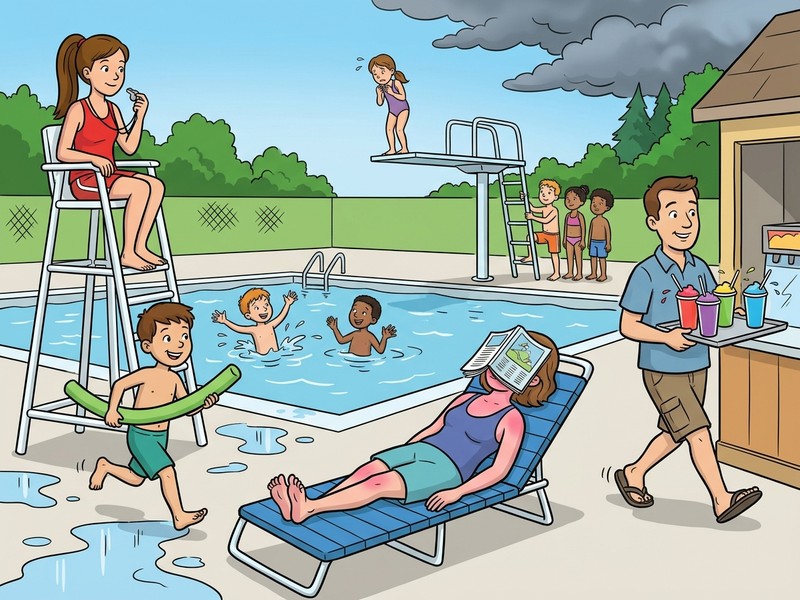
Switch between the two versions to see what changed between the first attempt and the second.
Things at this pool are about to change fast.1 On the left, the boy with the green noodle is running along the wet edge, and the lifeguard already has her whistle in her mouth. So he's going to get called out any second, and he'll probably end up on the bench. He won't be happy about that.2
The woman asleep on the lounge chair has pink shoulders. When she wakes up, she'll realise she's sunburnt, and she's going to be sore tonight.3 At the back, the girl on the diving board keeps looking down at the water. I think she'll climb back down the ladder, especially with all those kids waiting behind her. On the right, the dad's carrying a tray with four slushies, and it's already tipping. He might not make it to the table before one spills.4
Judging by those dark clouds, it's going to rain soon, so everyone will end up running for the change rooms.5
In this picture there is a swimming pool and many people. There is a lifeguard and there is a boy who is running.1 The boy will fall. There is a woman sleeping on the chair. She will wake up.2
The girl is on the diving board. She will jump in the water. The man is carrying drinks. He will give the drinks to his children.3
Then the man will go home and the woman will go home and the girl will go home too.4 It is a nice day at the pool.
The first attempt is about 90 words, and most of it describes. The second is about 160, at a steady, natural pace, and every sentence looks ahead. Aim for 130–160 words.
What keeps you at CLB 7
Try it now
Use the three moves on a new picture. Start the timer for your 30 seconds of preparation, then record your answer in the practice app for a CLB score.
What do you think will happen next in this picture?
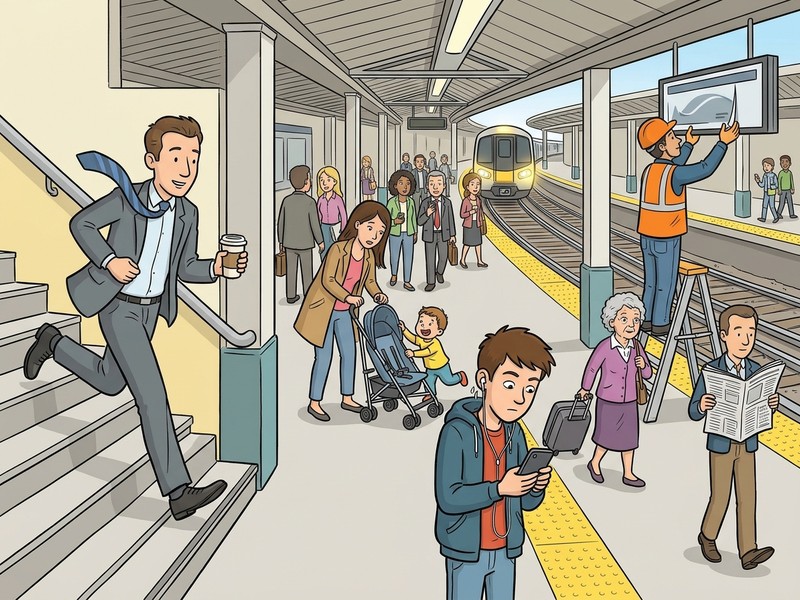
Recording and scoring open in the Celppro practice app.
Frequently asked questions
Do I need to describe the picture first?
No. The listener already heard about the scene in Task 3, so go straight into your first prediction. One short opening line is fine, but a full description uses up time and can cost you a level.
How many predictions should I make?
Aim for four or five. Three that each have a clue and a follow-on are better than six bare ones. A specific detail from the picture is what lifts a prediction from 8 to 9.
What if my prediction turns out to be wrong?
There's no right answer. Nobody knows what happens next in the picture. What counts is that each prediction comes from something the listener could see, like a clue you name.
Is it okay to use “will” every time?
It's not wrong, but it sounds like a list. Mix in “going to”, “might” and “probably”. That variety counts under vocabulary.
What if nothing in the picture looks like it's about to happen?
Look for people reaching, leaning, carrying too much or checking the time, and look at the sky. There are almost always four or five of these moments in a busy scene.
What if the timer cuts me off mid-prediction?
That's not marked down. CELPIP's own Level 9 and 12 samples are cut off. The final line about the whole scene is optional, so don't rush to fit it in.
Put this guide into practice
Try the strategy on a real Speaking task and get a CLB score straight away.
Deep scored CLB 12 in CELPIP and built Celppro after coaching students one-on-one. He reviews every guide against the current test format.